The Geometry of Emergence
Moving from flat planes to hyperbolic, fractal expansion. (And a few notes on the wisdom of lettuce.)
Recently, while following a breadcrumb trail that started with a conversation about why two discs of fabric sewn together do not form a sphere, I found myself down a rabbit hole exploring how different approaches to crochet can scaffold an inquiry into different kinds of geometry, and considering what geometry, yarn and lettuce might show us about human learning and potential.

This exploration emerged in phases, starting at the intersection of two interests that one of the children, Noleen, brought into the Wellspring Makerspace. One interest, firmly established, is crochet, and Noleen has worked this year non-stop adding to her repertoire of self-taught crochet techniques, which have resulted in the complex construction of various stuffed figures, including fully dressed dolls, each with their own unique style. Noleen never follows a pattern – she prefers to work it out herself, and the results always far exceed anything I could have tried to show her, no matter how carefully I thought through the different steps between where she is and where she wants to go.
Having hit a threshold in what she wanted to explore through crochet, Noleen decided to try her hand at sewing, and discover what she might be able to achieve with fabric, rather than yarn. Her first project was a cow-shaped stuffed doll, with the basic structure being a sphere. I watched as Noleen, ever intent on figuring things out without a pattern, cut two discs of fabric, joined them together, and was thoroughly frustrated that the joined discs did not result in a ball. At around about the same time, Noleen had expressed a separate interest in exploring mathematical concepts, and so this opened a conversation about the maths of circles and spheres, and how crochet is really an exploration of different kinds of geometry. Adding and subtracting stitches in a particular way forms a surface with positive curvature – a sphere – while a different stitch pattern may result in a flat surface, like a scarf, or a rug, which can be understood with a different set of principles – the Euclidean geometry of flat planes. Translating this into Noleen’s cow toy, the two discs sewn together were really just two flat circle-shaped planes, which don’t contain the conditions for the emergence of a sphere.
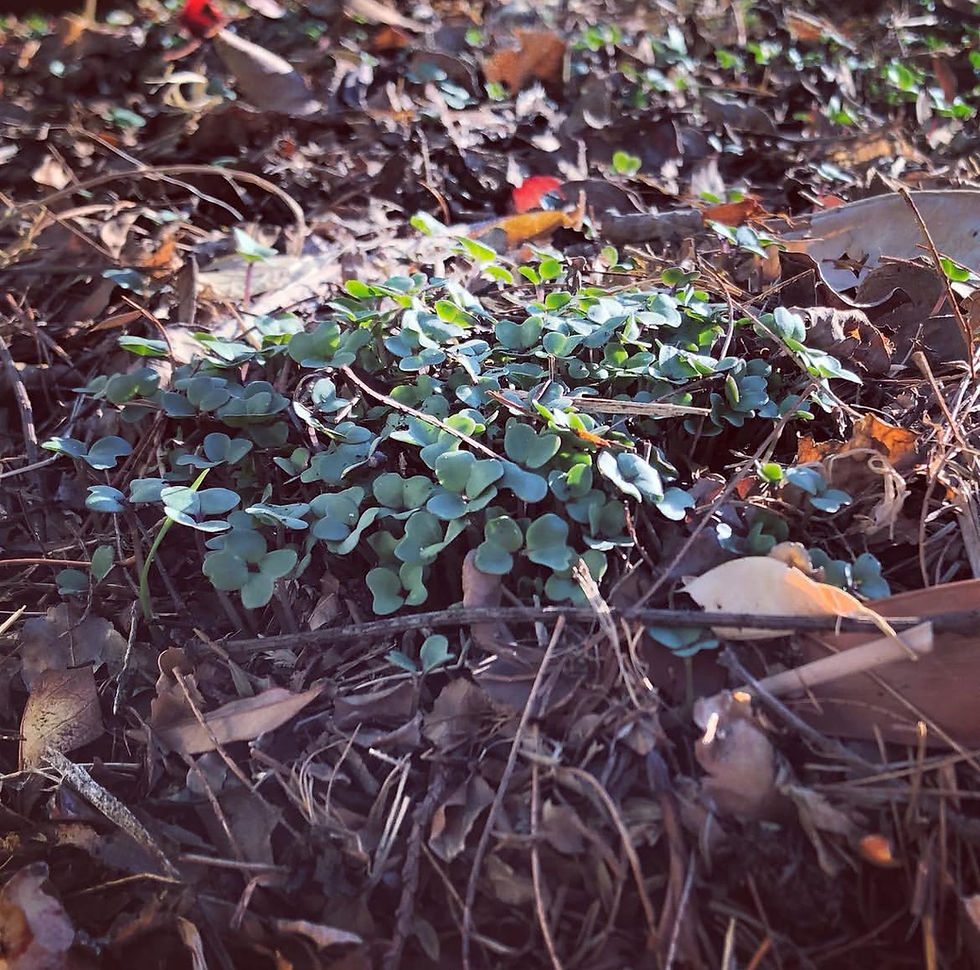
While thinking all this through, in my own explorations I came across hyperbolic geometry, a non-Euclidean geometry that describes surfaces with a negative curvature, which is found in nature all the time – think of frilly lettuces or seaweed or coral. Outside of lettuce, however, negative curvature is most easily experienced and visualised in the medium of crochet. In a wonderful case for making as a thinking process, as I began exploring these crochet constructions, they opened themselves up, very elegantly, as a way to understand what self-assembled, natural learning is really all about.
In most crochet, the process is underpinned by an outcome, which depends on following a specific set of instructions. Each stitch is prescribed, each row is planned, and if you deviate, the piece won’t “come out right.” The form is predetermined, and the maker’s role is to replicate a template faithfully. A flat crochet circle, for instance, stays flat because each round adds just enough stitches to accommodate its growing circumference. Add fewer stitches, and the edges curl up to form a bowl – or a sphere, if you follow these steps one way and then in reverse.

In contrast, hyperbolic crochet requires no script. The form arises not from a set of steps designed to yield a predictable outcome, but from holding a simple condition: keep adding more stitches than the flat fabric can contain. Now the circumference grows faster than linear — exponentially. There’s always more room than flat space expected. Out of these conditions emerges a fabric that curls and ripples, breaking out of the flat plane that is unable to contain it, into a living pattern — unique, unpredictable in detail, yet always revealing the deep geometry of hyperbolic space.
This is how nature creates – complex, adaptive and emergent. Life unfolds through and in response to conditions – sunlight, soil, season, relationship with other organisms in the ecosystem. Out of these, patterns emerge: spirals, branches, curves, waves.
And this is what self-assembled learning feels like.

Schooling is like instruction-following: linear, controlled, outcome-driven. While these outcomes can be measured relatively easily, I would argue that learning is not really what is being ascertained, but memorising of a certain kind of information. Human learning is really like hyperbolic crochet – think of the lettuce. Growth ripples outward with its own momentum, creating more and more space for learning.
We see this in our learning ecosystem every day, as each child’s curiosity makes continually more room for more exploration. Every step taken, opens up the possibility of multiple other steps. Which options open up, and which are pursued, is deeply personal to each child. Sometimes children are adding two stitches into every stitch. Sometimes they are adding thirteen stitches into every stitch. Sometimes, in times of rest or integration, they are on a “plateau” of one stitch per stitch.
Each child’s deep inquiry also contains nested patterns that echo in their peers’ exploration, which introduces fractal geometry into the metaphorical mix. Within our ecosystem, fractal patterns have always been a foundational way of understanding how learning happens. Fractal systems are created by patterns that repeat themselves at different scales in a never-ending feedback loop. Fractal geometry allows for infinite depth of detail. Metaphorically, it’s about boundlessness in relationship to scale. Zoom in, and you keep seeing structure within structure, with more pattern appearing the deeper you look.
So, if hyperbolic geometry offers us infinite expansion, and fractal geometry offers us infinite detail, then together they form a case for a paradigm defined by infinite space to grow, and infinite pattern within that space. In a nutshell, the metaphorical affordances of these geometric intersections invite us to consider a living, breathing, relational geometry of learning.
To someone trying to measure this with tools not fit for the job – like applying πr2 (the formula for calculating the area of a circle) to try and work out the surface area of the brain – this may look chaotic, messy, even terrifyingly “wrong.” To return to the idea of hyperbolic crochet, here’s the tension: hyperbolic space is infinite and smooth, but it’s being embedded in 3D Euclidean space with yarn. Euclidean space does not want to accommodate exponential growth along a surface, so the fabric ruffles, and folds to accommodate the excess. That rippling isn’t “error” – it’s the physical manifestation of negative curvature. To those who see it clearly, it is the most natural order – as natural as a coastline, a cauliflower, or a coral reef.


This is the heart of the paradigm shift: mainstream logics, like Euclidean geometry, are effective in their domain – measuring flat circles, or producing predictable outputs – but they collapse when applied to hyperbolic, fractal realities. Seaweed, coral, galaxies, and children’s self-directed learning can’t be understood through linear or binary thinking or standardised metrics of performance. Attempting to do so produces distortion, error, or dismissal. Emergence must be approached on its own terms.
And this is where our work as adults comes in. In our learning ecosystem, we are not the architects of a pre-designed structure. We don’t hand the children a template to follow, or ask them to memorise the template, in which every stitch is already prescribed. Our task is to hold the conditions in which hyperbolic, fractal growth is possible. This looks like many things, and it changes daily, based how every individual’s response to feedback loops intersects with every other individual’s response. Above all, it looks like time and space to follow threads of curiosity without interruption, and a culture of listening, where a person’s natural unfolding intelligence is treated as design feature rather than deviation.
In other words: we maintain the conditions, not the form.
The children then do what living systems always do: they self-assemble, they try, they test, they adapt, they discover. Their learning folds back on itself and stretches outward at the same time. Sometimes it looks still, sometimes it bursts into wild acceleration. What matters is not whether it looks efficient, but whether the conditions are sound.
While all this is truly very inspiring, this focus on emergence rather than compliance is not just a philosophical preference, or an aesthetic celebration of what learning could look like. It is essential, given the state of our world.
We are living in a time of rapid destabilisation and exponential technological advance. Old systems are collapsing in front of us: environmental, political, social, economic. The pace of change is dizzying, and the skills rewarded by the system called education — memorisation, obedience, narrow specialisation — are quickly becoming irrelevant, perhaps even perilous to pursue to the exclusion of all else.
What the world now requires are people who can orient themselves in uncertainty, according to their internal compasses. We need people who can adapt, question, connect and create; can notice patterns in chaos, tease out the threads, and weave new forms of coherence. We need people who can maintain a sense of curiosity in the face of disruption.
These qualities and capacities don’t generally emerge out of compliance. There are much more suitable conditions for their germination – such as lived practice in emergence, from growing up in environments where experimentation is the norm, where mistakes are encouraged, and where knowledge is not a static possession but an endlessly unfolding part of working out who we are, so that we can bring the best of ourselves forward to meet the world in which we live.
This is why we hold to the geometry of emergence: not because it is easier (it often isn’t), or because it guarantees certainty (it never does), but because it is aligned with life itself.
In the process of leaning into these geometric metaphors, I have begun referring to the children in our learning ecosystem as wise lettuces. It always invites a chuckle, but underneath it is really a nod to a deep feeling of privilege and humility – we are surrounded by these wildly intricate and complex organisms called children, emerging and adapting in ways that we could never predict, let alone script in advance.
This is the true work (beautiful, challenging and necessary) of our ecosystem: to be a living demonstration that education can be other than what we have become accustomed to, and that children, when given space and trust, grow into precisely the kinds of beings our uncertain world most needs. The children will lead the way, wise lettuces that they are, if we have the courage to let them.


이용 과정이 간단하고 업무 설명이 명확해서 부담 없이 시작할 수 주점알바 관련 후기도 많아 참고하기 좋았고 실제 근무 환경도 설명과 비슷해 만족스러운 경험이었습니다.
장시간 운전 후 이용했는데 서비스 덕분에 다리와 허리 피로가 빠르게 풀렸어요 . 동탄출장마사지 압 조절이 적당해서 더욱 편안하게 받을 수 있었습니다.
필요한 순간 바로 사용할 수 있어서 편리했고 중간에 소액결제상품권 조건까지 좋아서 여러 번 재이용하고 싶은 서비스였습니다.
전체적으로 깔끔하고 효율적인 구조라 만족도가 높았습니다. 서비스는 빠른 처리와 상품권현금화 친절한 안내가 장점이며 반복 이용에도 부담이 없었습니다.
요즘처럼 스트레스가 많은 생활 속에서 이런 서비스는 큰 도움이 됩니다. 예약도 간편하고 시간 맞추기도 쉬워서 부담 없이 이용할 수 있었습니다. 관리사의 실력이 좋아서 뭉친 근육이 풀리고 혈액순환이 좋아지는 느낌을 받았습니다. 특히 조용한 환경에서 받을 수 있어서 더욱 편안했습니다. 출장마사지 서비스는 집에서 휴식을 원하는 사람들에게 정말 좋은 선택이라고 생각합니다.